
The football world is still buzzing after a breathtaking Champions League night that delivered not only a moment of pure brilliance on the pitch, but also an unexpected and deeply revealing exchange off it. At the center of it all stands Eberechi Eze, whose stunning goal against Bayer Leverkusen has already sparked conversations about whether it deserves a place among the greatest goals ever scored in the history of the game.
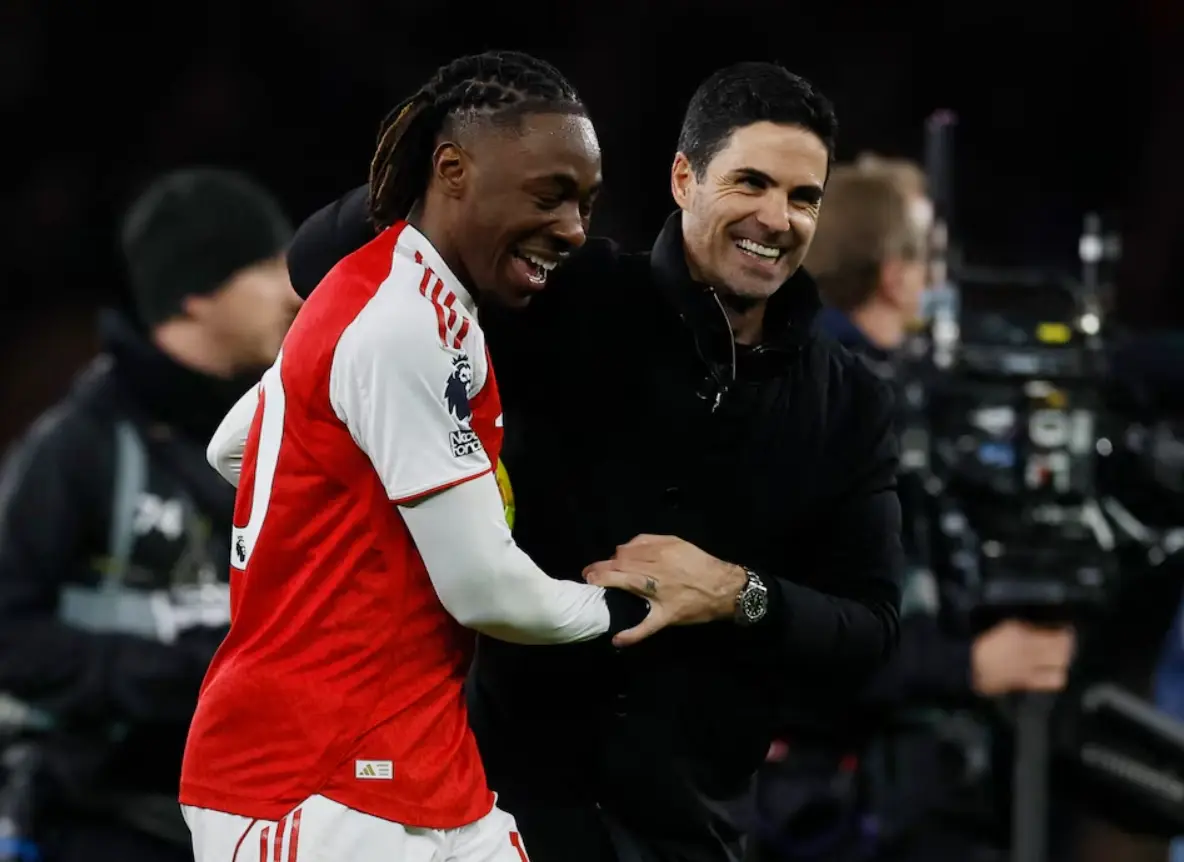
Yet, as remarkable as the goal itself was, it is what happened after the final whistle — specifically, a conversation with Mikel Arteta — that has captured even greater attention.
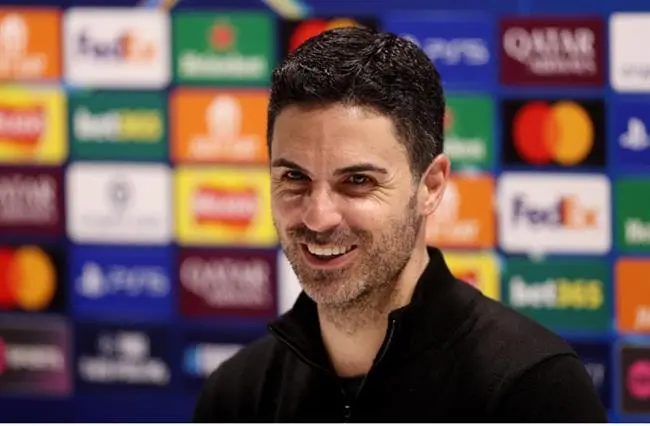
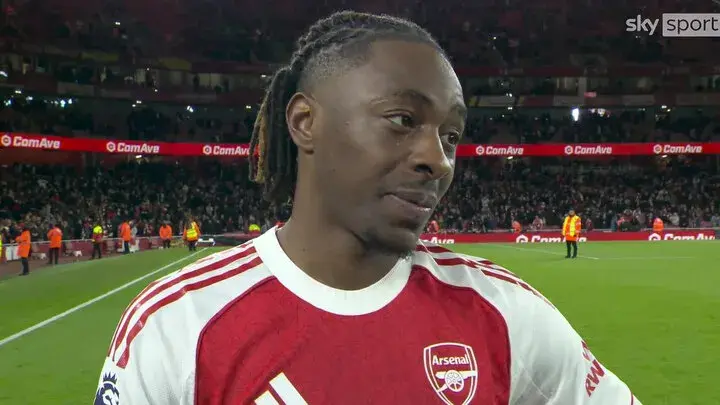
Eze, speaking candidly after the match, did not hide his pride. “I scored the most beautiful goal in football history yesterday,” he said with a mix of confidence and emotion. While such a claim might sound exaggerated to some, those who witnessed the moment understand why he feels that way. It was not just a goal; it was a piece of art.
The move began deep in midfield, where Eze picked up the ball under pressure. With a quick turn that left one defender off balance, he accelerated into space. What followed was a sequence of movements that seemed almost choreographed — a glide past one opponent, a delicate touch to evade another, and then a sudden burst of speed that split the defensive line of Bayer Leverkusen wide open.

As he approached the edge of the box, the stadium held its breath. Instead of opting for a conventional finish, Eze executed an audacious strike — a curling effort that arced perfectly into the top corner, leaving the goalkeeper rooted to the spot. The crowd erupted instantly, a mixture of disbelief and admiration echoing around the stadium.
Moments like these are rare, even at the highest level of football. They transcend tactics and statistics, reminding fans why they fell in love with the game in the first place. And for Eze, it was clearly a defining moment in his career.
However, the narrative took an unexpected turn after the match when Eze revealed his conversation with Mikel Arteta. Known for his analytical mind and measured demeanor, the Arsenal manager is not typically associated with emotional or impulsive reactions. That is precisely why his words left such a strong impression.
“I expected him to just say ‘great goal’ or something like that,” Eze admitted. “But what he told me really surprised me.”
According to Eze, Arteta’s reaction went far beyond simple praise. Instead of focusing solely on the beauty of the goal, he delivered a message that combined admiration with insight — a hallmark of his coaching philosophy.
“He told me that moments like that are not just about talent,” Eze explained. “He said it’s about courage — the courage to do something different when everyone expects you to play it safe.”
That statement, while seemingly straightforward, carries significant weight in the context of elite football. At the highest level, players are often conditioned to minimize risk, to prioritize efficiency over creativity. Decisions are made in fractions of a second, and the margin for error is extremely small. In such an environment, attempting something unconventional can be seen as reckless.
Arteta, however, appears to view it differently. His message to Eze suggests a belief that true greatness lies in the willingness to take risks — to trust one’s instincts even under immense pressure. It is a philosophy that aligns with the evolving identity of Arsenal FC, a team that has increasingly embraced fluidity, creativity, and attacking expression.
For Eze, hearing this from a manager of Arteta’s caliber was both surprising and inspiring. “It made me think,” he said. “Because sometimes you doubt yourself in those moments. You think, ‘Maybe I should pass, maybe I should play it simple.’ But he was saying the opposite — that those are the moments where you have to be brave.”
This exchange sheds light not only on Eze’s mindset but also on the broader dynamics of modern football. The game has become increasingly structured, with tactical systems dictating player behavior to an unprecedented degree. While this has led to higher levels of consistency and organization, it has also raised concerns about the diminishing role of individual creativity.
Goals like the one Eze scored serve as a reminder that there is still room for spontaneity. They highlight the importance of players who can break the mold, who can produce something unexpected when it matters most. And according to Arteta, those moments should be celebrated — not discouraged.
The reaction from fans and pundits has been overwhelmingly positive. Social media platforms were flooded with clips of the goal, accompanied by comparisons to some of the most iconic strikes in football history. While debates about “the greatest goal ever” are inherently subjective, there is little doubt that Eze’s effort will be remembered for years to come.
What makes the story even more compelling is the contrast between the individual brilliance of the goal and the collective nature of the sport. Football is, at its core, a team game. Success depends on coordination, discipline, and shared responsibility. Yet, within that framework, there are moments where individuality takes center stage — moments where a single player can change the course of a match.
Eze’s goal was one such moment. And Arteta’s reaction underscores the importance of recognizing and nurturing that individuality, even within a structured system.
For Bayer Leverkusen, the goal was undoubtedly a painful one to concede. Defensively, they were not necessarily poor; rather, they were undone by an exceptional piece of skill. In such situations, there is often little that can be done. Sometimes, you simply have to acknowledge the quality of the opposition.
From a tactical perspective, the match itself was highly competitive. Both teams demonstrated a clear game plan, with periods of dominance shifting back and forth. However, it was Eze’s moment of brilliance that ultimately defined the narrative.
As the Champions League campaign progresses, performances like this can have a significant psychological impact. For the player, it boosts confidence and reinforces belief. For the team, it serves as a reminder of what is possible when talent and courage align. And for opponents, it introduces an element of unpredictability — a recognition that they must always be prepared for the unexpected.
Eze’s comments also hint at a broader evolution in his own game. Known for his technical ability and flair, he has sometimes been criticized for inconsistency. Moments like this, however, suggest a player who is beginning to combine creativity with decisiveness — a combination that can elevate him to the highest level.
The influence of figures like Mikel Arteta should not be underestimated in this context. Even a brief conversation can leave a lasting impression, shaping a player’s mindset and approach. In Eze’s case, it appears to have reinforced a belief in his own instincts — a belief that could prove crucial in future matches.
As discussions continue about the goal and its place in football history, one thing is clear: it has already achieved something important. It has sparked conversation, inspired admiration, and reminded everyone of the beauty of the game.
Whether or not it truly is “the most beautiful goal in football history” is ultimately a matter of opinion. What is not up for debate is its impact — both on the night itself and in the days that have followed.
For Eberechi Eze, it is a moment that will likely define his career. For Mikel Arteta, it is an example of the kind of football he believes in. And for fans around the world, it is a reminder that, even in an era dominated by tactics and analysis, there is still magic to be found on the pitch.